There are few
people in this world for whom Plato’s “Allegory of the Cave” is more relevant college students. In Plato’s
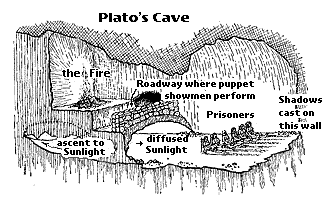
writing he describes two men, trapped in a cave, who believe what they see is
reality. Yet all they see are the
shadows of objects cast by a fire. They
have never seen sunlight or anything else outside of the cave. They have only seen shadows inside their
cave, nothing we would call “real.” Their
reality is not “real,” they just believe it to be that way. At some point, one ventures outside the cave
to smell the air, see the sunlight. Many
of our journeys as college students outside the cave will occur when we
graduate from college, secure a job, and, for the first time ever, enter the
“real world.”
Our entire world thus
far has been a construct, created by those who have laid out our paths in front
of us, for us to do nothing but waltz down.
We didn’t pick the cave, we were born into it. For a lot of us students, what we currently
consider to be reality was largely formed by others. The “real world,” the sunlight, can blind us,
it can scare us. Multitudes of college
students in their final years fret about securing a job and living on their
own, once and for all outside the grasps of their parents. We like being in the cave, and we like the
reality that is life in the cave.
Around graduation time, those leaving the cave can be heard lamenting
about going into the sunlight and stepping outside of what they’ve known as
reality so far. The cave is secure and
the cave is something we know. If we
fail in the cave, or in college, there is always another opportunity or another
chance. If I fail a class, I can always
take it next semester. We are afraid
because we know that life outside the cave is unknown, it’s not planned out for
us, and it’s not guaranteed.
 Socrates equated the journey
outside of the cave to an enlightenment of sorts, a coming of age. This couldn’t be more accurate for those
whose academic careers are abruptly ending and along with it the financial and moral
support of their parents. Once you have
left the cave, there is no going back, there is no safety net. Every single graduate’s most frightening
realization is, “if I fail, only I pay the consequences.”
From this
perspective, it seems like leaving the cave and graduating is all gloom and
doom. Some may look at this process as
dreadful and scary. But according to
Socrates and Plato, isn’t the journey outside the cave something special and
something to be cherished? To them, is
it not the ultimate journey a human can make?
Graduating and having the opportunity to get a job and support oneself
is an opportunity. It is a blessing and
a test to prove ourselves and will ultimately define whom we are. So when that day inevitably arrives, let us
not walk out the cave fearfully, but stride out into the “real world” and enjoy
life on the outside.

When I initially think of college as an example of the allegory of the cave I think more of the comparison of life before college when we are living directly under the control of our parents. The way that you present it is a much better way of thinking about it because we can think of college as our journey out of the cave but not quite in the real world yet. There is an obvious sense of insecurity that can be expected to be felt when leaving college but as you pointed out there is also an optimistic way of thinking about it. College or the cave can also be viewed as something that is an obstacle for people before they can truly become what they want to become just like how when you become enlightened you are able to do things that you couldn't do before.
ReplyDeleteKilling it Wold. I like this metaphor a lot. I never really saw the connection between college life and the cave, but I can definitely see how it relates. Unfortunately for us college students, there is little revealing of life outside of the cave in the "real world" until we are thrust into it for ourselves. It would be nice if, as in Plato's work, the people brought outside the cave to the "real world" would come back to the college students and attempt to share some insight on what life outside the cave is like, but unfortunately that happens too little.
ReplyDeleteJack, you make numerous great metaphors and solid points. I had never thought of this analogy before, and it definitely works. There are, however, a few points I disagree with. First off, in Plato's "Allegory of the Cave," the men literally have never seen anything but the shadows, so the shadows are therefore their only reality. On the contrary, college students often times get glimpses of the "real world," as they obtain internships and observe the professional life through their parents, relatives, and older friends. Additionally, I disagree with your statement: "Our entire world thus far has been a construct, created by those who have laid out our paths in front of us, for us to do nothing but waltz down." Although this may apply to some students, many other students have had to construct their own paths without the help of their parents or guardians. However, I agree with virtually everything else you say, and it is definitely worth noting some of the interesting connections you draw. For example, this is a great analogy: "Around graduation time, those leaving the cave can be heard lamenting about going into the sunlight and stepping outside of what they’ve known as reality so far. The cave is secure and the cave is something we know." Lastly, your concluding paragraph is very strong, and you ask interesting questions within it.
ReplyDeleteJack, I really loved reading your post, because this is the exact metaphor I thought of when asked in discussion for an example of Plato's Allegory of the Cave in the real world. As you wrote in clarity, college is a clear real-world example of the cave. I have likened college to a utopia of our real world. Yes, it's technically the real world, where we are confronted with decisions and choices that emulate those that we will make once we graduate, yet these choices and decisions are really only just shadows of the ones we will be making in the actual real world. I personally don't want to leave the cave at all; I'm really enjoying this "cave," and I fear the day I have to leave it.
ReplyDeleteThis fear is exactly why I enjoyed your post so much, because you brought up how Socrates and Plato viewed this journey out of the cave as something that must be cherished. The journey is extremely challenging, yet that is exactly why it is so rewarding, for it forces the development of the individual. It essentially forces us to grow up, and recognize that there is a real world that exists. As great and amazing as the cave is to the human, it is the journey outside of it that is the most rewarding and the thing that must be wanted to be attained in the end. Leaving the cave is a test and reminder that we must remain strong in the face of any adversity, and as you said, remain confident as we "stride out" into the real world. We really should be happy that we have the privilege to enter the real world. Great post!
Yes, but in the college example the "cave" is meant to prepare you for the real world, whereas in Plato's allegory it is sort of a prison that keeps you from the real world. And when in college we are constantly reminded of the real world, not hidden from it, as we have internships, co-op etc. However, I like the idea that college is more forgiving and thus we tend to get more comfortable in it.
ReplyDelete