When reading Machiavelli’s The Prince for class, what I found to be the most intriguing
element, and perhaps the most vital, was Machiavelli’s commentary on whether it
was better to be loved or feared. Which is the most important in order to
sustain power, and why? Ideally, Machiavelli states that a prince should be
both feared and loved. However, due to the fact that this is not always
realistically attainable, he states that it is much better to be feared than
loved. By applying these ideas to three characters in the much-loved series Harry Potter, we can begin to understand
how this philosophy is applicable in both fictional (to the non-believers) and
real-life situations.
On Being Loved
For those of you who don’t know, the beacon of light in the
midst of all the darkness in the Harry
Potter series is Albus Dumbledore, headmaster of Hogwarts School. An entirely
benevolent character, he is wise and compassionate, epitomizing goodness in the
entire series.
 |
| Albus Dumbledore |
Consequently, he is almost universally loved (with the exception
of Voldemort and his following, the “Death Eaters”).
 |
| Voldemort's "Death Eaters |
He uses the philosophy of leading through loving and being loved, saying to Harry in the fifth book (Harry Potter and the Order of the Phoenix) that love is “the power that you possess in such quantities and which Voldemort has not at all.” However, Dumbledore’s desperate conquest for goodness and justice eventually leads to his demise. Due to a mistake that Dumbledore made when he was younger, resulting in his sister’s death, he seeks out the “Resurrection Stone,” a magical device that would allow him to communicate with the dead. He sought this stone in order to apologize to his sister and parents for the mishap. An additional result of his mistake when he was younger resulted in Dumbledore being incredibly good for the rest of his life, avoiding having too much power for fear of a reoccurrence of what had happened when he was younger. Due to his desperate desire to set things right by using the resurrection stone, he winds up placing a cursed ring containing the stone on his hand. This curse results in Dumbledore only having a year to live, and, due to complications in the story that I will neglect to cite here for the sake of conciseness, winds up requesting Snape (a character playing a double agent) to kill him.
As we learned in class, Machiavelli holds that to be
compassionate and merciful are very admirable qualities for a leader to have.
However, leaders must be very careful not to use these qualities unwisely.
While I am not asserting that Dumbledore repeatedly used these qualities
unwisely, it was due to his rash decision to put on the cursed ring in order to
atone for his mistakes that led to his downfall. I am, by no means, saying that
it was entirely due to Dumbledore’s good qualities that he perished in the end.
Rather, I am saying that his death is symbolic of Machiavelli’s assertion: that
being too good will lead to unfavorable consequences.
On Being Feared
Voldemort, a stark contrast to Dumbledore, is a physical manifestation of pure evil. Tortured by a troubled past with sociopathic tendencies, Voldemort is on a quest to rule the wizarding world through fear and dark magic.
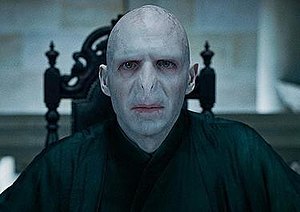 |
| Lord Voldemort |
In doing so, he employs
Machiavelli’s technique of rule through fear. It is by threatening his
followers with the most horrible consequences that he accrues the loyalty that
he does in the series. He stands by this philosophy, his heart hardened to the
idea of love, saying in the sixth book (Harry Potter and the Half-Blood Prince), “But nothing I have seen in the world
has supported your famous pronouncements that love is more powerful than my
kind of magic, Dumbledore.” When it comes down to the end of the series, and
Voldemort is trying to kill Harry Potter, his arch nemesis, Voldemort ultimately
fails. This is due to the fact that Voldemort (through a complicated series of
events) uses Harry’s blood to resurrect himself. According to the story,
Harry’s blood is protected by his mother’s love, and due to the fact that this
blood coursed through Voldemort’s veins, he was incapable of killing Harry.
Machiavelli asserts in The
Prince that if it comes down to whether a leader must choose between being
feared and being loved, “it is far safer to be feared than loved.” Or, as he says more eloquently in the following photo:

Voldemort
utilizes Machiavelli’s strategy of ruling through fear to a T. As Machiavelli
says, “… fear is bound by the apprehension of punishment which never loosens
its grasp,” and Voldemort capitalizes on this assertion. From a leader’s
perspective, Voldemort did an excellent job of doing this, as he gained a loyal
following who supported him until the very end. However, Voldemort still
ultimately failed.
-----------------------------------------
The reason I chose to compare these characters from Harry Potter to The Prince is due to the fact that I thought it incited thought as
to which strategy was the best. Clearly, as emotionally invested audience
members of Harry Potter, we want the good to prevail. The fans of Harry Potter loved Dumbledore, and were
so sad to see him die, as he did a great job of leading through love and being
loved. However, from a purely objective point of view, Voldemort’s strategy of
ruling through fear was also incredibly effective. While both characters wind up perishing, ultimately love
does triumph over fear in the conclusion of the series.
By applying Machiavellian principles to characters from a
beloved pop culture saga, the conflict of being loved vs. being feared becomes
more discernible. Ultimately, outcomes aside, whose strategy do you think
Machiavelli would have approved of were he still around today?
Links to images cited:
http://upload.wikimedia.org/wikipedia/en/thumb/f/fe/Dumbledore_and_Elder_Wand.JPG/300px-Dumbledore_and_Elder_Wand.JPG
Sources cited:
https://docs.google.com/a/umich.edu/viewer?a=v&pid=sites&srcid=dW1pY2guZWR1fHBvbHNjaTEwMWYyMDEyfGd4OjI3Y2M3MjY5ZmE2NDBmNjk
York, NY: Arthur A. Levine, 2005. Print.
Rowling, J. K., and Mary GrandPré. Harry Potter and the Deathly Hallows. New York, NY: Arthur A. Levine, 2007. Print.

It is unbelievably fascinating to me how the beloved Harry Potter series is applicable to so many things in life. I loved the series, and I really liked how you tied its themes into Machiavelli's writing. Just to push back on your arguments a little bit, I was questioning if Dumbledore "ruled," for lack of a better word, completely with love. He is a character held in high esteem, he is respected for his seemingly infinite wisdom, but isn't this facet of his personality in some ways aiding his power? The students and the other teachers, while they don't ever directly fear Dumbledore as the wizarding world fears Voldemort, but there is a certain tint of fear it seems? Look at our own education: that one great teacher that you loved might have been really nice, but part of the reason they were such a good educator was that they held you to expectations. Failure to uphold these expectations is often a source of fear. I think it is indisputable about Voldemort and his ruling through absolute fear. Finally, in reference to your last question, I have to say that I think Machiavelli may have endorsed Dumbledore. Voldemort's tactics prompted most of the wizarding world to rally behind Harry, so through the Machiavellian lens, I think this demonstrates poor leadership.
ReplyDeleteYour analysis is interesting but there's a few points on which I have to disagree with you. From my last reading of The Deathly Hallows (which I'll admit was years ago) it seems as if Dumbledore is a Machiavellian figure for reasons other than those you've pointed out. Rather than exemplifying pure good as a counterpart to Voldemort's pure evil, Dumbledore is power-thirsty and manipulative, seemingly comfortable with using others as means to ends-- even those who place complete trust in him, such as Harry. Dumbledore is good in a purely utilitarian sense, as all of his string-pulling and mechanizing are done in the interest of the collective good. Voldemort, on the other hand, is not a Machiavellian figure. Wicked as he is (and one-dimensionally so, which I always found to be a problem in terms of his characterization), Voldemort demonstrates little interest in the good of the state. He is entirely self interested, which is not a trait of Machiavellianism.
ReplyDeleteNicholas, I agree that Dumbledore personifies a Machiavellian figure much better than Voldemort. I just have a small contention with your reasoning, specifically with your feeling that Dumbledore was a power-hungry individual. Considering an ideal Machiavellian figure acts to benefit the state and not himself, your labeling of Dumbledore as “power-hungry” doesn’t seem to support his Machiavellian characterization. However, I think your point about Dumbledore’s manipulative side is right on. He was definitely willing to sacrifice Harry for the good of the Wizard world, which is an essential quality of a Machiavellian figure. On the other hand, Voldemort was pure evil and did nothing for the good of the state. Voldemort compares well with Hitler, who, as we established in lecture, was not a Machiavellian figure.
ReplyDeleteIn reference to Sara’s comment, I think Dumbledore was also feared because he was such a powerful wizard. Voldemort even attests to this when he claims Dumbledore is the only wizard he ever feared. Dumbledore induced a sense of fear which complimented his benevolent nature to make him a successful ruler.