In the wake of my 18th birthday, I have found
myself reflecting on the last 18 years of my life as I enter the unknown
territory of manhood. One of the defining characteristics of my childhood was
my obsession with the MMORPG Runescape. From the ages of 10 to 13, every minute not
spent eating, sleeping, or studying was blown on exploring the lands of Gielinor, racking up experience points, and chasing
Runescape riches (in the form of gold coins). I have experienced harsh
trade regulations, hyperinflation, and even loss of (virtual) life. Occasionally,
I log in during breaks to see what’s new with the game; after playing during
the Thanksgiving holiday, I’ve realized that Runescape is a play on Locke’s
idea of the social contract.

Look it's a Runescape turkey!
According to Locke's Second Treatise “Whosoever
therefore out of a state of nature unite into a community, must be understood
to give up all the power, necessary to the ends for which they unite into society,
to the majority of the community...And this is done by barely agreeing to unite into one
political society, which is all the compact that is”. Like any online game,
Runescape has its players agree to a Terms and Conditions that prevents them
from stealing accounts, making real money transactions and libeling other
players (they still do it anyway). Jagex, the creator of Runescape, recognizes Locke’s idea of property in his Second Treatise—“The labour that was
mine, removing them out of that common state they were in, hath fixed my property
in them”—by allowing players to keep whatever items they acquire from
completing actions such as fishing, mining, woodcutting, etc. Jagex protects
players’ property by providing a PIN system for the in-game banks, allowing
players to keep 3-4 items upon respawning and not providing a mechanism for
other players to steal items (items may only be acquired from other players
through free trade). Players’ right to life is protected by blocking
player-killing in the majority of areas in Runescape.
However, Runescape puts a twist on Locke’s idea
of the social contract by giving players the chance to willingly enter a state
of war. Locke describes the state of war
as “a state of enmity and destruction” and provides its remedy: To avoid this
state of war is one great reason of men's putting themselves into society. But In
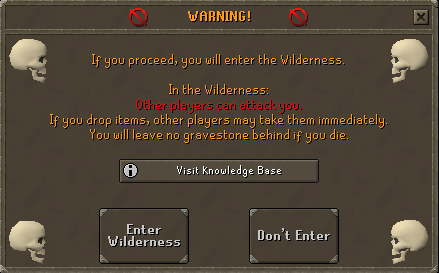
Runescape’s society, there is a vast wasteland known as the Wilderness in which
players are allowed to kill each other freely. Upon approaching the Wilderness border,
Runescape warns players of eminent danger and allows them to choose whether to enter the Wilderness. This yes or no question
is a simple social contract: players give consent to the possible loss of life.
In fact, total war is possible in Runescape. There are special worlds known as “Clan
Wars” in which groups of players can team up to take down other players in
large-scale battles.
Runescape is unique in that it provides players
several versions of the social contract. There is a general social contract
that all players must abide to regardless of world. Then, there are subsequent
social contracts in each world that effect gameplay. The social contract in
player-killing worlds and activities is a twist on Locke’s intention for the
social contract: to emerge from the state of nature and the state of war into
civil society.


Syed, nice blog man. I used to obsessively play RuneScape back in my middle and early high school days too; I also log on every once in a while to see what's new too (by the way, the new combat update sucks)! So I can definitely relate with this article.
ReplyDeleteI agree with your idea that deciding to play RuneScape is like entering a social contract - however, it's different in the sense that while Locke's social contract is to escape the state of nature, RuneScape's is simply to escape the "state of boredom." The other thing that Jagex exemplifies wonderfully about the social contract, is that if you break it (by scamming, cursing, etc), you can get banned, which is akin to getting shunned from a society. Also, I really like how you brought up the point of property, even if its virtual. Having been hacked once and losing all my possessions on RuneScape, I know how frustrating it can be to lose a few pixels property that I attained through hours of clicking lol. I'd also like to extrapolate a little on this idea of property. Locke believed in the labour theory of property, which states that goods produced by nature are valueless - only one's input of labour makes that item valuable. I think this would also apply to pretty much any skill in RuneScape. Whether you're chopping down a Yew tree to fletch longbows, or you're killing Green Dragons in level 20 Wilderness to sell dragon bones, these items are worthless without your labor.
However, on that labor point, I would also like to point out the fact that bots (programs that automatically cut trees, kill dragons, etc for you) exist in the game, which can make it very unfair.
I also laud you on your introduction of the Wilderness and how it represents the state of war. It's interesting how people in a society such as RuneScape would choose to go back to the state of war. I think this could be the result of people's items still retaining their value, although they are present in a state of nature (kind of goes against Locke's theory of property, but hey, it's just a video game). Ex: Whether I'm outside of Varrock bank or in the Wilderness, my white partyhat (ha, I wish) is still worth 500 million gp.
I never realized how well RuneScape portrayed the idea of a social contract, but you made the connection quite clear in this post.
Nihir, you are probably right about the idea that playing Runescape is more like escaping a "state of boredom" than escaping the state of nature. The stakes outlined by Hobbes' state of nature are much higher. According to Hobbes "if any two men desire the same thing, whichnevertheless they cannot both enjoy, they become enemies; and in the way to their end, (which is principally their own conservation, and sometimes their delectation only,) endeavour to destroy, or subdue one another." In Runescape, if two players want to mine the same coal or cut the same tree, the game lets multiple players attempt to do so, and (usually) the one with the higher skill gets the rock. Even with drops, the player with the faster reaction time gets the item. There is no foulplay involved. The only place players get to kill each other for items is the Wilderness.
ReplyDeletePlayers are in no danger if they choose not to play Runescape, whereas in the state of nature, no man is safe. As Hobbes said "there is no way for any man to secure himself, so reasonable, as anticipation; that is, by force, or wiles,to master the persons of all men he can, so long, till he see no other power great enough to endanger him: and this is no more than his own conservation requireth, and is generally allowed." Most players are playing to procrastinate rather than fighting for their survival.
Thus, I agree that Runescape's social contract is not an escape from the state of nature. But the requirements of a social contract still hold. Players are bounded by the rules of the game, and failure to comply results in banning. Every player agrees to the Terms and Conditions by their own free will.