“What is your biggest fear?” This was a security question
that I had to provide an answer for when I was signing up for my email account,
so that I could recover my password easily if I were to ever forget it. At the
time I didn’t think much of the question. I just wrote down “heights,” figuring
that if it was the first thing that came to mind now, it would be the first
thing to come to mind when if I ever needed to recover my password. This,
however, is an age old question. What makes us afraid? And what role does fear
play in motivating us?
This guy is obviously not afraid of heights...
When it comes down to it, humans are rational creatures.
Like any other animal, we seek to maximize the pleasure in our lives and
minimize the pain. A rational human being would, first and foremost, want to
live and be alive. However, I am not entirely comfortable with making this
statement. I would then have to assume that pain to humans is equated with death,
with varying degrees of severity. This is not always true as it fails to take into
account the richness of character that humans possess. People can feel
emotional pain, as well as sympathy and empathy for others. These are all
things that can be considered undesirable. Therefore I cannot say that the root
of fear is death, although it is true in many cases. There is something even
deeper, even more conclusive, that I believe is our greater fear.
 |
| If only fear could be described as simply as this... |
I read a book recently that was a child’s firsthand account of
his battle with cancer. One of the most striking lines in the book was spoken
by a friend this child had met in the hospital. When confronted with the fact
that he might die, the friend responded by saying “I’m not afraid of death, I’m
afraid of dying.” This was really surprising to me. Aren’t these two concepts
the same thing? Isn’t dying just a process leading to death? But then I
realized what he was talking about. He was not afraid of death because it’s
just a emptiness; he figured he wouldn’t even know he was dead. He was afraid
of the process of it all, of being plunged into the unknown, taken away from
everything that he was familiar with. I had figured it out: our greatest fear
is what we don’t know; it’s uncertainty.
FDR once said that the “only thing we have to fear is fear
itself.” But what exactly is fear, if not the culmination of everything that we
don’t know, that we don’t understand, that is uncertain? What is fear, but the
future? Kant says that the reason it is so hard for people to break the bonds
of immaturity is because they’re so comfortable with a life of being told what
to do, how to live, and how to think. The reason we’re so comfortable being
such a conformist species is because following others gives us guidelines and
guarantees, things that are certain. This is why we feel the need to make
social contracts, to have laws and societies. We need to feel safe, and the
only way to feel safe is if through order and the removal of as much
uncertainty as possible.
Unjustified terror? More like unknown terror.
Kant claims that we become enlightened when we “have courage
to use [our] own understanding.” It is not a coincidence that he characterizes
the use of free thought with being courageous. It’s a scary thing to have to
rely on ourselves, to tackle the things that we don’t know without any guidance
or support. Furthermore, Kant says that if we fail in our attempts to walk
alone, we will be frightened out of further attempts. I also consider this fear
of failure to be a fear of the unknown, as it is uncertain whether or not we
will succeed. But how are we then to be truly enlightened, to emerge fully from
our immaturity? The entire process of human development is characterized by
fear of the unknown. Children are attached to their parents because it is the
only thing that they are certain of. When they start to stray from the nest in
an attempt to discover the unknown for themselves, they become adolescents. And
finally, after a thorough amount of life experiences, when enough of the
unknown becomes known, they become adults.
There is still, however, uncertainty in everyone’s life,
regardless of age or enlightenment. Even the most enlightened and most thoughtful
person cannot control one thing: the future. Even though I am technically an
adult trying to make my own way through the world, I have never been more
afraid in my life. My future has always been one giant unknown variable but I’ve
always viewed it as something that I’ll figure out “another time.” Well that
time has come, the time to make the decisions that will impact me for life. It’s
time to make decisions about the classes I’m going to take, the disciplines
that I’m going to study, the job that I might be able to get, and the lifestyle
that I will eventually live. According to Kant, I should not be afraid to make
the decisions that I truly believe in. But part of me can’t help but wish that I
had someone telling me what to do, whether it was a parent telling me what type
of job I should get in the future, or an academic adviser telling me what type
of disciplines would be best suited for me, or even a peer telling me which classes to avoid. At least I could use some of their experiences to help me
unravel part of the uncertainty.
But another part of me wants to believe that all this
uncertainty is part of the beauty of life. Kant says that we do not live in an
enlightened age, but that we do live in an “age of enlightenment.” I think this
classification is universal to any time period; we never stop discovering
ourselves, no matter what stage of life we are in. We’ll never really know it
all. We are always exploring and learning, becoming more and more enlightened. Maybe
that’s the beauty of it all, that our fears add excitement to our lives. Maybe
we need to embrace the uncertainty and channel it into liveliness. Maybe that’s
what part of true enlightenment is, to live freely, not only from the guidance
of others, but from the fears of tomorrow.
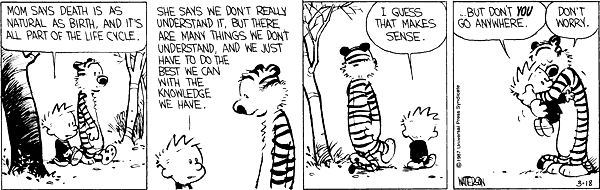 |
| "We just have to do the best we can with the knowledge we have." |
Tower Climbers Working. 2010. Web. 28 Nov 2012. <http://www.youtube.com/watch?v=2A_h2AjJaMw>.
FDR's First Inaugural Speech. 2009. Web. 28 Nov 2012. <http://www.youtube.com/watch?v=amNpxQANk0M>.
"The Importance of Certainty." DET-CMS.
Center for Applied Motivation Inc., n.d. Web. 28 Nov 2012.
<http://www.det.wa.edu.au/detcms/school-support-programs/gifted-and-talented/teachers/resources-and-links/eager/related-research-articles/the-importance-of-certainty.en?oid=MultiPartArticle-id-2001047>.
Kant, Immanuel. "What is Enlightenment?." theliterarylink.com. The Literary Link, n.d. Web. 28 Nov 2012. <http://theliterarylink.com/kant.html>.
Watterson, Bill. Calvin and Hobbes.
N.d. Comic Strip. Sbnation.comWeb. 28 Nov 2012.
<http://cdn2.sbnation.com/imported_assets/1025956/cal_hobb-raccoon9.jpg>.

Jack, this post was a great read with many interesting points. Throughout my life, I have given a lot of thought to fears and death. In response to your point about the child in the book, "Ways to Live Forever," I too came to realize a while ago that I wasn't at all afraid of death. Just as the child's friend said, “I’m not afraid of death, I’m afraid of dying.” I have seen and watched family members die and observed that the toughest, most painful, and scariest part of it all isn't death itself, but the process of it. However, I disagree that what this means is that we're afraid of the unknown. I think if we were afraid of death (not dying) then that would mean we're afraid of the unknown because in my opinion death is the unknown. By being afraid of dying, I think we are afraid of the pain, the wait, the potential loneliness to come, and leaving behind close ones and the world. Anyways, the rest of your post was spot on and I think you do a great job of relating this all to Kant.
ReplyDeleteI agree with you, Jack, and also with Ryan. My biggest fear is the ocean. The worst possible scenario I can picture is being stranded in the middle of the Pacific, floating. It would be absolutely terrifying. Fish and underwater life is FASCINATING, but that doesn't quell my fear of not knowing what all is underneath me--there is so much in there that we don't know about, and it's full of uncertainty. I love how you related this all to Kant; you did it very smoothly. I understand Ryan's argument that we should be afraid of death if we're afraid of the unknown, but I think it can be construed as you describe it. I think the process of dying, or experiencing someone dying, is one of the worst things a person can face. At death, there's no unknown because we aren't conscious of it. While dying, it's one big unknown. How will life be? What should I do with this person's last moments? When it's all said and done, all we can do is recover from the pain, but before they're gone for good it is the most terrifying. Regardless, I love your arguments and that video of the guy on the tower is ridiculous. Yipes.
ReplyDeleteI think that being too smart and analytical sometimes aids fear. Like you said, even the enlightened have a lot to fear. Sometimes you just have to stop thinking and take the plunge. And in my opinion, the only way to conquer fear is to go out and do it. There may be many fancy visualization tricks and psychological techniques, but that is just sophistry to me. You can't trick the brain to be unafraid, you can only desensitize it to what makes it afraid. So start small and confront that fear on your own turf, starting with a small instance of that fear and work your way up.
ReplyDelete